From grand Baroque halls filled with centuries-old books to architectural masterpieces that feel almost otherworldly, these extraordinary libraries prove that places created for knowledge can also be some of the world’s most beautiful spaces.
There is something particularly magical about a beautiful library.
Perhaps it is the combination of silence and grandeur, the smell of old books, the intricate craftsmanship of the shelves, or the feeling that generations of people have stood in exactly the same room searching for knowledge.
Some libraries are spectacular because of their architecture. Others because of their collections. And a few manage to combine both into spaces that feel almost like works of art.
From Austria and Ireland to Portugal and the Czech Republic, these are some of the most beautiful libraries in the world — places where books, history, architecture and art exist under the same roof.
1. Admont Abbey Library — Admont, Austria
If there were a library designed specifically to make visitors stop in their tracks, it might be the library at Admont Abbey.
Located inside a Benedictine abbey in the Austrian Alps, the Admont Abbey Library is one of the great masterpieces of European late Baroque architecture.
The library hall was completed in 1776 and stretches approximately 70 metres. Its brilliant white-and-gold interior is filled with carved wooden details, monumental sculptures and seven ceiling frescoes by Bartolomeo Altomonte. Around 60,000 volumes are visible within the hall, while the abbey’s wider collection contains around 200,000 works.
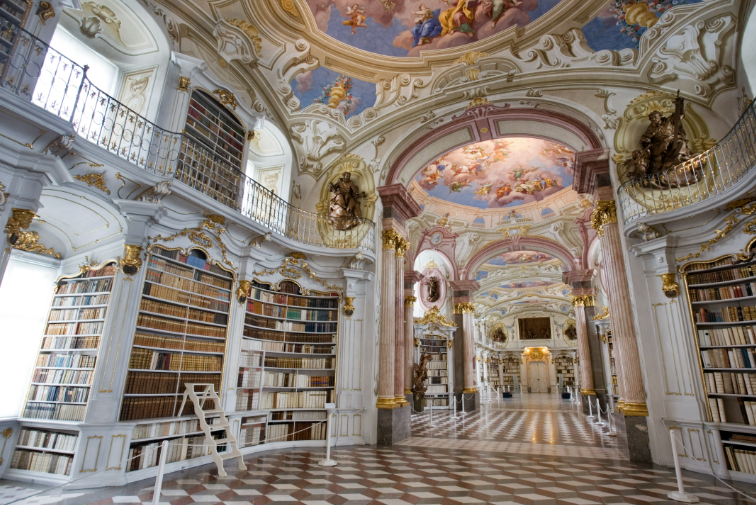
What makes Admont particularly extraordinary is the way its architecture was conceived around the relationship between knowledge and light.
The space was deliberately designed to feel open and luminous, with large windows illuminating the white shelving and elaborate Baroque decoration. The seven frescoes represent stages in the development of human knowledge, making the library feel less like a storage room for books and more like an enormous visual interpretation of learning itself.
The result is wonderfully theatrical without feeling cold.
White bookshelves rise toward the decorated ceiling, golden details catch the light and sculptures stand between the books as if the room itself were a museum.
Discover the Admont Abbey Library
Light should fill the room as well as the mind.
The idea behind Admont’s design could hardly be more appropriate for a library: architecture becomes part of the experience of learning.
2. The Long Room at Trinity College Dublin — Dublin, Ireland
Few libraries are as instantly recognisable as the Long Room at Trinity College Dublin.
The magnificent chamber forms the main room of the university’s Old Library and stretches nearly 65 metres beneath its famous barrel-vaulted ceiling.
Construction took place between 1712 and 1732, but the room eventually required expansion as Trinity’s collection grew. In the 19th century, the roof was raised and the upper gallery and barrel vault that give the Long Room its distinctive appearance were added.
The atmosphere is unmistakable.
Tall oak bookcases line both sides of the room, while marble busts of philosophers, writers and figures connected with Trinity stand between the shelves.
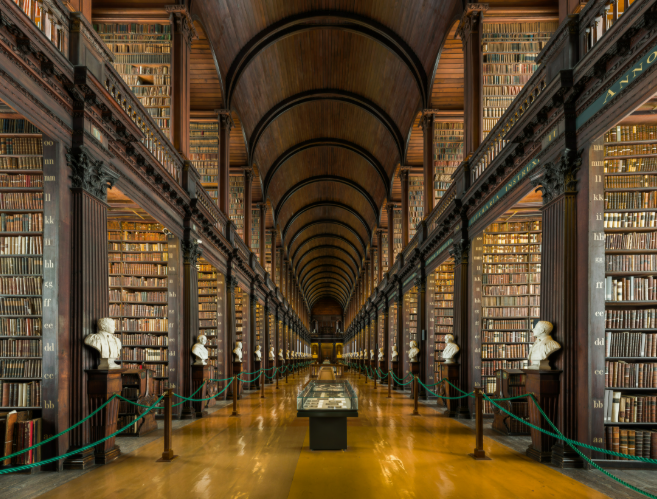
The Long Room has traditionally held around 200,000 of the library’s oldest books, although the collection is currently being moved as part of the Old Library’s major conservation and redevelopment programme.
That restoration is particularly important because the Old Library is not simply a beautiful historic interior. Trinity’s library dates back to the foundation of the college in 1592 and today holds more than six million printed volumes, alongside manuscripts, maps, music and other collections.
The Long Room therefore represents something larger than its extraordinary appearance: centuries of accumulated knowledge transformed into architecture.
Explore the Long Room at Trinity College Dublin
3. Joanina Library — Coimbra, Portugal
Inside the historic University of Coimbra sits one of Europe’s great Baroque libraries: the Joanina Library.
Completed in 1728, the library was commissioned during the reign of King João V, whose portrait presides over the Noble Floor.
The interior is divided into three richly decorated rooms, each with shelves and galleries covered in carved ornamentation and painted details. Black, red and green backgrounds provide a dramatic setting for the gilded decoration, while arches connect the three spaces.
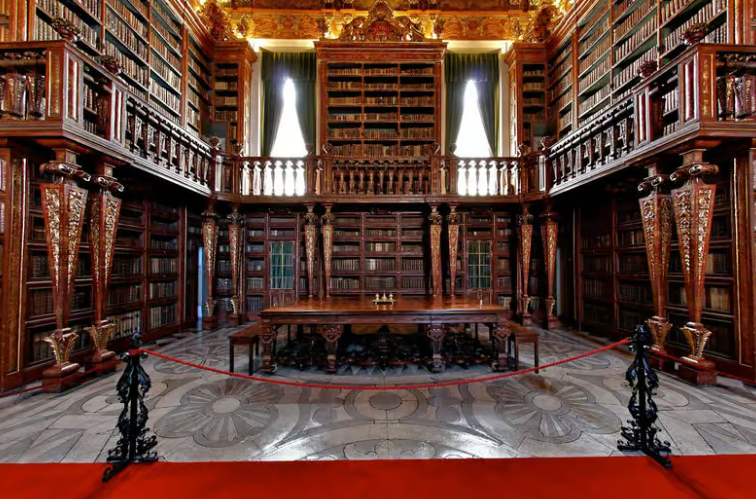
It is extravagant in the most traditional Baroque sense.
There is gold, carved wood, painted decoration and an almost theatrical sense of symmetry. Yet the books remain the heart of the room.
The library holds approximately 60,000 books dating from the 16th to the 18th centuries, covering a wide range of subjects. The collection is still considered an important part of the University’s heritage.
The history of the University Library goes back even further. A library is documented at Coimbra as early as 1513, long before the construction of the magnificent Joanina building.
Today, the Joanina Library is also part of the UNESCO World Heritage setting of the University of Coimbra, making it not only a library but part of one of Portugal’s most significant historic university complexes.
Discover the Joanina Library at the University of Coimbra
EDITOR’S NOTE
The most beautiful libraries aren’t necessarily the ones with the most elaborate decoration. What makes these spaces unforgettable is the feeling that the architecture was created to honour the books, ideas and people contained within it.
4. Strahov Library — Prague, Czech Republic
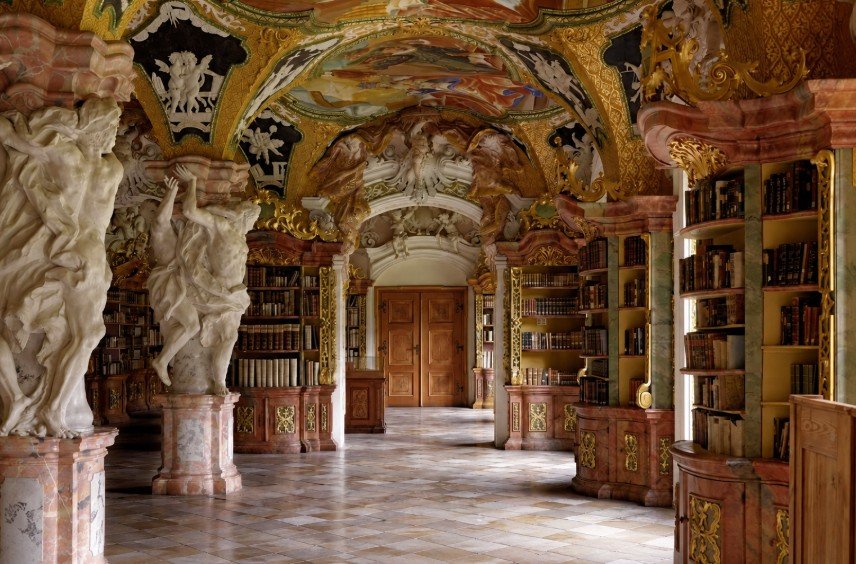
In Prague, the historic Strahov Monastery is home to two spectacular library halls: the Theological Hall and the Philosophical Hall.
The library has existed at the monastery since its earliest period, although its history through the medieval centuries is only partly documented.
The Theological Hall was constructed in the 1670s under Abbot Jerome Hirnheim. More than a century later, the larger Philosophical Hall was built between 1782 and 1797 under Abbot Václav Mayer.
The Theological Hall is particularly dramatic, with Baroque decoration, carved wooden details and frescoes devoted to themes of wisdom.
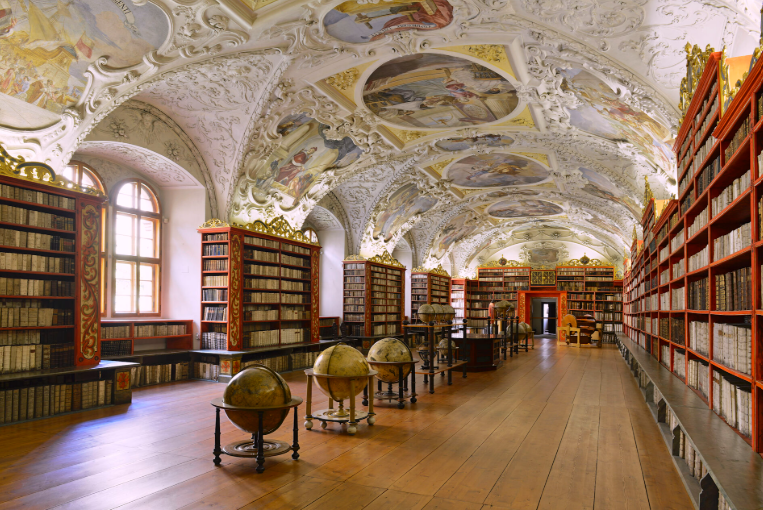
The Philosophical Hall takes the grandeur even further. Its enormous ceiling fresco, painted by Franz Anton Maulbertsch and his pupil Martin Michl, depicts the spiritual development of humanity and fills the upper part of the room with an extraordinary sense of movement.
The library is also fascinating because it reveals how historical libraries were organised.
Decorative cartouches above the shelves indicated different fields of knowledge, turning the architecture itself into a visual guide to the collection.
Even today, the monastery carefully limits access to the historic halls because humidity brought in by visitors can affect the books and the delicate interiors.
5. George Peabody Library — Baltimore, USA
Moving from European Baroque grandeur to American architectural drama, the George Peabody Library in Baltimore offers an entirely different interpretation of the beautiful library.
The library opened in 1878 and was designed by Baltimore architect Edmund G. Lind in collaboration with Nathaniel H. Morison, the first provost of the Peabody Institute.
Its most striking feature is the spectacular central reading room.
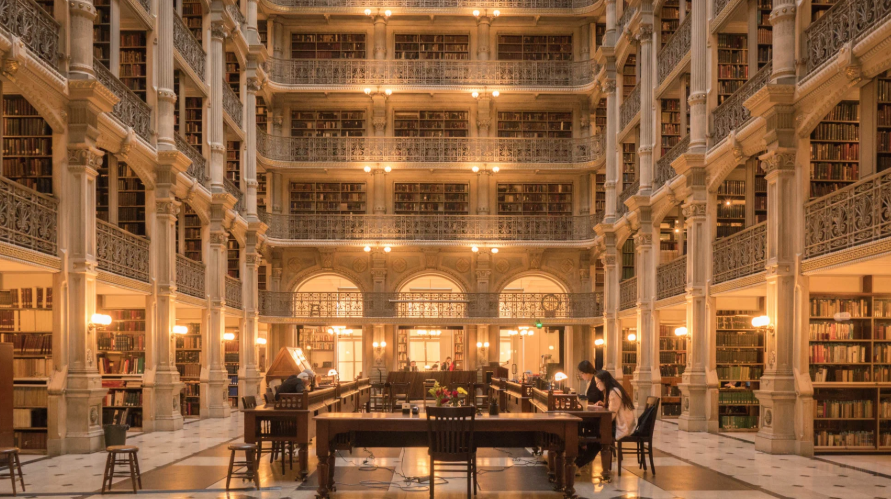
Five tiers of ornamental cast-iron balconies rise toward a skylight approximately 61 feet above the floor, creating an almost cathedral-like vertical effect.
Instead of the richly painted Baroque interiors found in Admont or Coimbra, the George Peabody Library relies on repetition, symmetry, ironwork and light.
The result is surprisingly theatrical.
More than 300,000 volumes form part of the library’s collection, with particularly strong holdings in subjects including British and American history, art and architecture, literature, geography and exploration.
And despite its extraordinary appearance, this is not simply a museum piece. The George Peabody Library remains part of the Sheridan Libraries at Johns Hopkins University and continues to serve teaching, research and readers.
Discover the George Peabody Library
6. The Morgan Library & Museum — New York, USA
In the heart of Manhattan, the Morgan Library & Museum offers a very different kind of library experience.
Its historic core was originally the private library of financier and collector J. Pierpont Morgan. Designed by Charles Follen McKim and completed in 1906, the library was created to house Morgan’s growing collection of rare books, manuscripts, drawings and prints.
The interiors are remarkably intimate compared with the monumental scale of some European libraries.
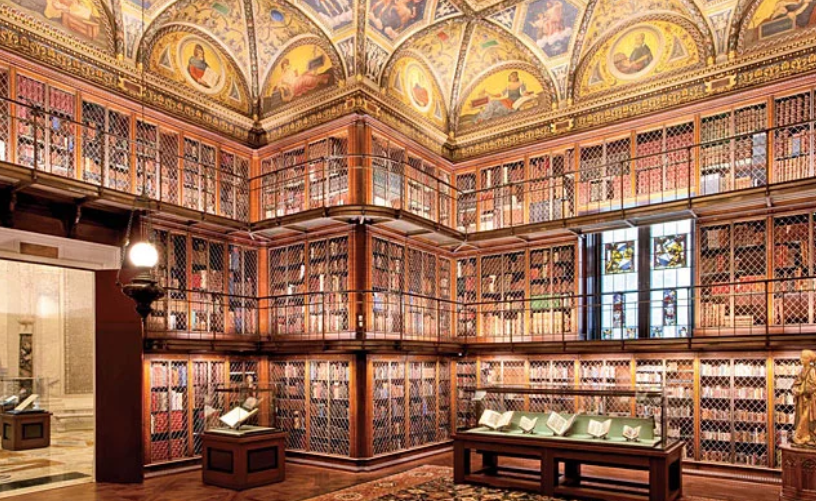
The Rotunda is particularly impressive, with marble surfaces, mosaic panels, lapis lazuli columns and a richly decorated domed ceiling. From the Rotunda, three historic rooms radiate outward, including Morgan’s library and his private study.
The Study may be the most personal space of all.
Its Renaissance-inspired ceiling was assembled from an antique wooden ceiling purchased in Florence, while stained-glass panels, Italian silk-inspired wall coverings and Renaissance works of art contribute to the room’s extraordinary sense of richness.
What makes the Morgan so fascinating is the balance between private luxury and public culture.
The library was transformed into a public institution in 1928, allowing its collections to be shared with scholars and visitors. Today, the historic library forms part of a larger museum campus that also includes a modern expansion by architect Renzo Piano.
It feels less like a conventional library and more like stepping into the private intellectual world of an extraordinarily wealthy early-20th-century collector.
Discover the Morgan Library & Museum
7. The Oval Room at the Bibliothèque nationale de France — Paris, France
Paris has no shortage of beautiful cultural spaces, but the Oval Room at the Bibliothèque nationale de France’s Richelieu site deserves particular attention.
The room’s construction began in 1897 and was completed in 1932. Its enormous oval form measures approximately 43.7 metres long, 32.8 metres wide and 18 metres high.
The architecture is immediately recognisable.
A huge central skylight illuminates the room, while gilded acanthus decoration and sixteen glazed oculi create an elegant rhythm around the upper walls.
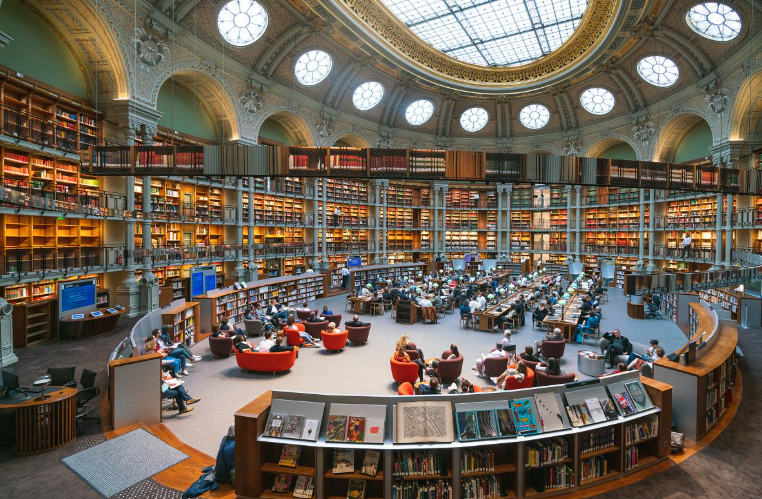
The room reopened after restoration in 2022 and is now freely accessible to the public. It contains more than 20,000 books available for consultation, alongside a large collection of comics and resources covering art and cultural heritage.
That combination makes the Oval Room especially interesting.
It looks like an imposing historic reading room, but it isn’t frozen in the past. Visitors can encounter traditional reference books alongside digital resources and contemporary collections.
The result is a beautiful example of how a historic library can remain relevant without sacrificing its architectural identity.
And perhaps that’s what makes the room so appealing: it feels grand enough for history, yet open enough for modern life.
Explore the BnF Richelieu Oval Room
DID YOU KNOW?
The Oval Room is not simply a beautiful place to visit. It is still a working public reading room, with 160 study seats and thousands of works available for consultation.
8. The Rose Main Reading Room — New York Public Library, USA
Few interiors capture the idea of a grand American library quite like the Rose Main Reading Room at the New York Public Library.
Located on the third floor of the Stephen A. Schwarzman Building, the room measures approximately 78 feet by 297 feet and has ceilings rising 52 feet above the floor.
Its scale is extraordinary.
Long rows of reading tables extend beneath enormous murals depicting luminous skies and clouds, while thousands of reference books line the shelves around the room.
The architecture belongs to the Beaux-Arts tradition, combining classical grandeur with the atmosphere of a serious place of study.
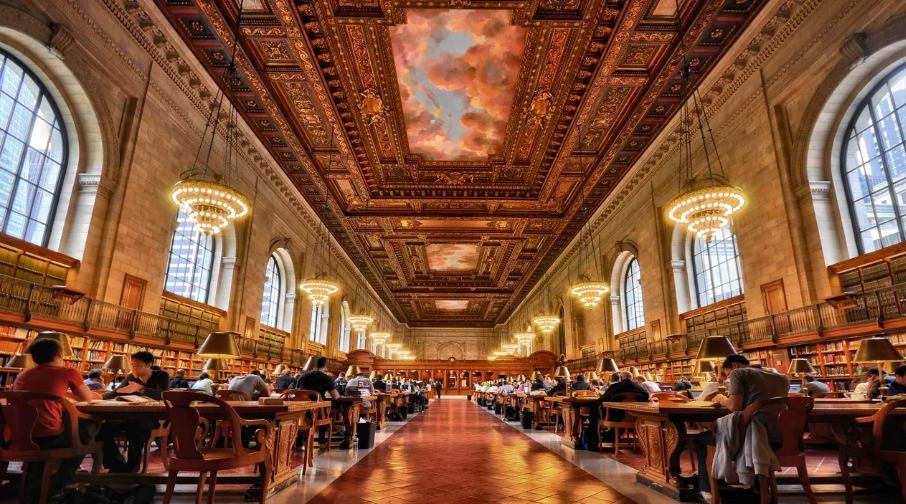
But the Rose Main Reading Room has never simply been decorative.
For more than a century, writers, journalists, historians, students and researchers have used the room as a place to gather information and develop their work. The library has also undertaken extensive restoration to preserve its historic interiors for future generations.
That distinction matters.
There is something particularly beautiful about a room that looks like a monument but continues to function as a living intellectual space.
Rather than being preserved behind glass, the architecture remains part of everyday research and discovery.
Visit the Rose Main Reading Room at the New York Public Library
9. Real Gabinete Português de Leitura — Rio de Janeiro, Brazil
In Rio de Janeiro, the Real Gabinete Português de Leitura offers one of the most dramatic library interiors in South America.
The institution houses approximately 350,000 works by Portuguese authors, making it an important centre for Portuguese literary culture outside Portugal.
But it is the interior that makes visitors immediately understand why the building has become such an iconic cultural landmark.
The main reading room is filled with towering shelves, carved architectural details and an extraordinary sense of verticality. Books rise several levels above the central reading area, creating the impression of a miniature cathedral dedicated to literature.
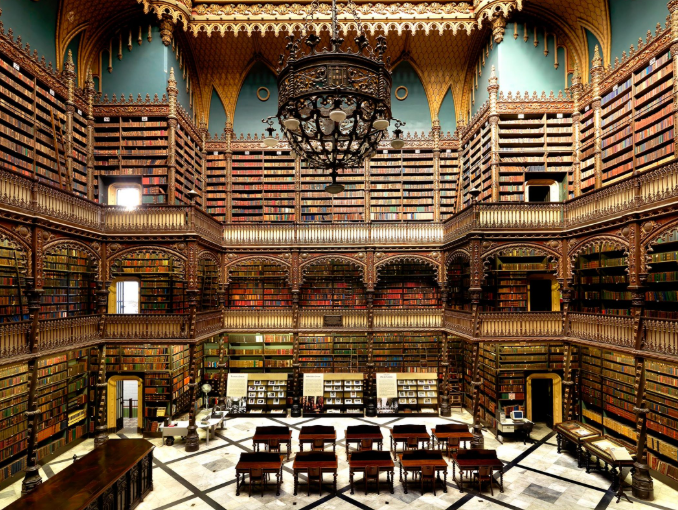
There is also something wonderfully theatrical about the contrast between the dark wooden shelves and the light that filters through the upper part of the room.
The library’s identity is closely tied to the Portuguese community and its literary heritage in Brazil, making it more than an architectural curiosity.
It is a reminder that libraries can also preserve the cultural memory of a country far beyond its borders.
The institution continues to maintain its library collection and offers a virtual tour and visitor information through its official website.
Explore the Real Gabinete Português de Leitura
10. Stuttgart City Library — Stuttgart, Germany
After so many historic interiors, Stuttgart City Library provides a dramatic change of mood.
The building, which opened in 2011, is a minimalist concrete-and-glass cube located near Stuttgart’s main railway station.
From the outside, it looks almost severe.
Inside, however, the architecture becomes surprisingly serene.
The main interior is almost entirely white, with books providing the strongest visual accents. Open staircases and galleries create a series of interconnected levels, while the central reading space is designed around a large, luminous cube-like room.
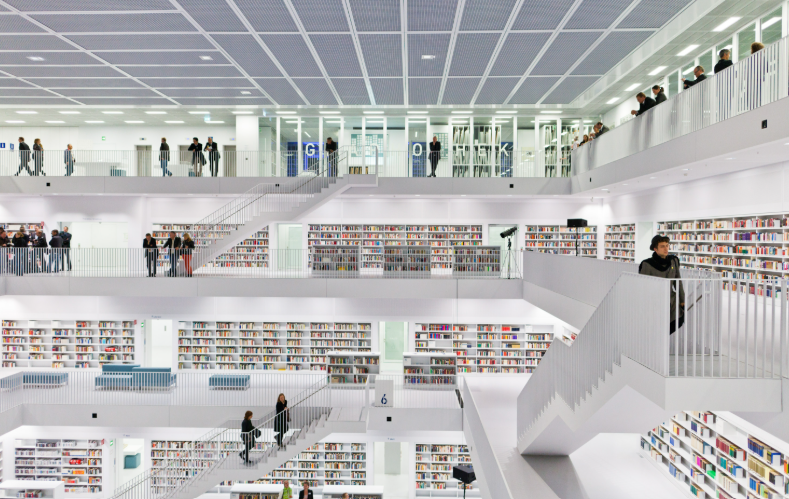
The contrast with libraries such as Admont or Strahov could hardly be greater.
There are no Baroque frescoes, gilded ceilings or carved wooden bookcases.
Instead, the beauty comes from simplicity, geometry, light and space.
The city itself describes the library as an open and bright “temple of books,” and it has become one of Stuttgart’s most recognisable architectural landmarks.
It proves that a library does not need centuries-old decoration to feel extraordinary.
Sometimes, restraint can be just as powerful as ornament.
Discover Stuttgart City Library
What Makes a Library Truly Beautiful?
Looking at these spaces together, an interesting pattern emerges.
Beauty doesn’t come from one particular architectural style.
Admont is an explosion of late-Baroque light and colour. Coimbra embraces Portuguese Baroque decoration. Strahov combines theology, philosophy and monumental frescoes. Trinity creates drama through height, symmetry and centuries of books. George Peabody transforms iron balconies and natural light into something almost theatrical.
What connects them is something simpler:
They treat knowledge as something worthy of beautiful surroundings.
And perhaps that is why extraordinary libraries continue to fascinate us, even in an age when so many books can fit inside a phone. Beautiful libraries don’t belong exclusively to the past.
Some of the world’s most memorable libraries combine historic collections with contemporary architecture, while others demonstrate how a reading room can become an extraordinary expression of a city’s culture.
Just as some libraries become destinations because of their extraordinary architecture, museums can offer the same experience. Discover The Most Beautiful Museums in the World, where art, architecture and culture come together in remarkable spaces around the globe.
A World of Libraries, A World of Architectural Styles
Looking across all ten libraries, it becomes clear that there is no single definition of beauty.
Admont celebrates Baroque splendour.
Trinity College Dublin creates drama through repetition, height and historic books.
Joanina transforms the library into a celebration of Portuguese Baroque craftsmanship.
Strahov turns theological and philosophical knowledge into visual storytelling.
George Peabody uses iron, symmetry and natural light to create a monumental American reading room.
The Morgan feels intimate, luxurious and deeply personal.
The BnF Oval Room demonstrates the elegance of historic French architecture while remaining a contemporary public reading space.
The Rose Main Reading Room combines Beaux-Arts grandeur with everyday scholarship.
Real Gabinete Português de Leitura preserves Portuguese literary heritage in the heart of Rio.
And Stuttgart City Library proves that modern minimalism can be just as memorable as centuries-old ornament.
Together, they tell a much bigger story about architecture.
A library can be a monastery, a palace, a private collector’s sanctuary, a university hall, a civic landmark or a contemporary architectural statement.
But the purpose remains remarkably consistent:
to create a place where people can pause, think, discover and imagine.
CURIOSITY
The beauty of these libraries isn’t only in their architecture. Notice the details that create atmosphere: symmetry, warm wood, dramatic lighting, repeated shapes, beautiful materials and carefully framed views. These are the same principles that can make a home feel more elegant.
From extraordinary libraries to monumental places of worship, architecture can completely transform the way we experience a space. Explore Sheikh Zayed Grand Mosque: The Story, Design & Secrets Behind Abu Dhabi’s Icon for another remarkable example.
Why We Still Fall in Love With Beautiful Libraries
In an age when an entire library can fit inside a laptop, tablet or phone, it might seem strange that physical libraries still have such a powerful emotional pull.
But perhaps that is exactly why they matter.
A beautiful library asks us to slow down.
It gives knowledge a physical presence.
The height of a ceiling, the weight of a wooden door, the sound of pages turning and the sight of thousands of books arranged around a room all create an experience that cannot be replicated by a search bar.
These buildings also preserve something that digital technology cannot fully reproduce: a sense of continuity.
The people who designed these rooms could never have imagined today’s digital world, yet their spaces remain useful, admired and visited.
That is an extraordinary achievement.
If the beauty of these grand libraries inspires you to create your own little retreat at home, discover How to Create a Cozy Reading Corner at Home for ideas on turning even a small space into an inviting place to read.
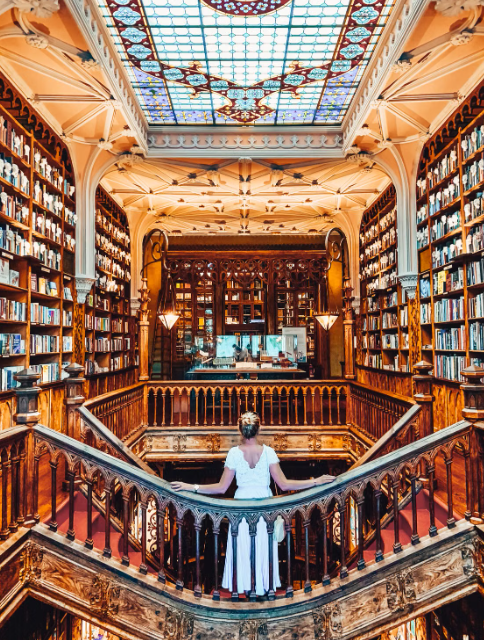
Libraries preserve more than books — they preserve languages, ideas and the ways different cultures understand the world. Continue your cultural journey with Beautiful Words From Around the World That English Can’t Quite Translate.
If you love beautiful spaces where you can slow down with a book or a coffee, don’t miss our guide to The Most Beautiful Cafés in the World, exploring some of the world’s most atmospheric coffeehouses.
Final Thoughts
The world’s most beautiful libraries remind us that knowledge has always been considered worthy of beautiful surroundings.
If you enjoy creating intimate spaces surrounded by beautiful books, you may also like our guide to How to Style a Beautiful Bedside Table, where books become part of an elegant and functional bedroom arrangement.
From the gold and frescoes of Admont to the minimalist geometry of Stuttgart, each library expresses a different idea of what a space for learning can be.
Some are monuments to religion.
Some to scholarship.
Some to private collections.
Some to civic life.
And some simply celebrate the pleasure of being surrounded by books.
Perhaps that is why these libraries continue to fascinate us.
They aren’t just beautiful buildings.
They are beautiful invitations to stay awhile, look closer and discover something new.